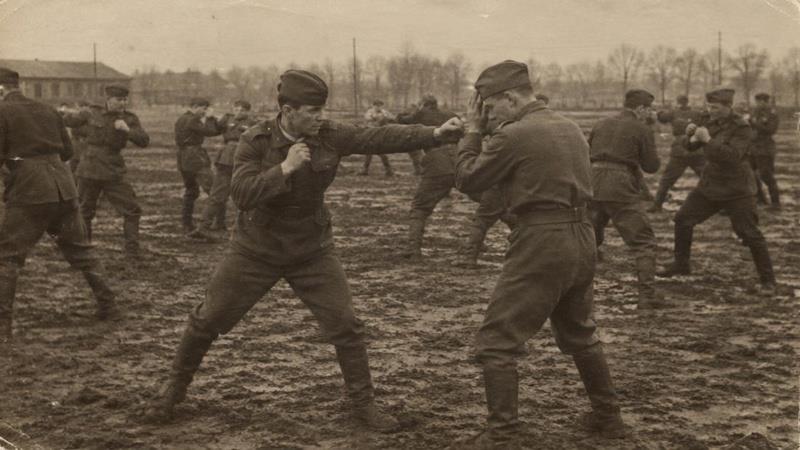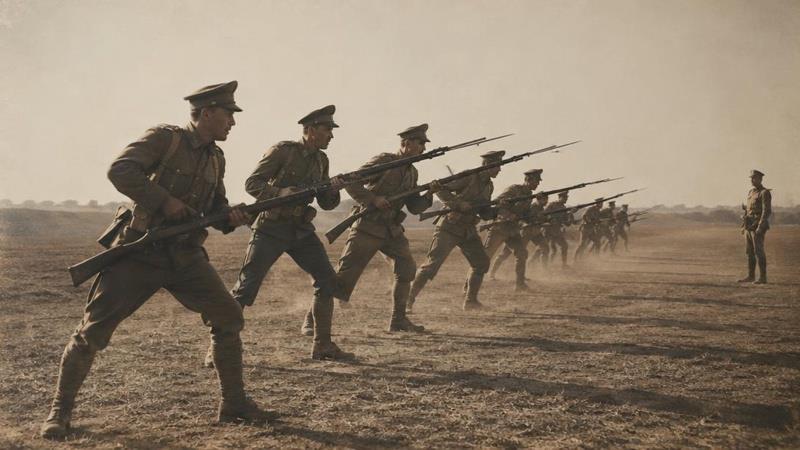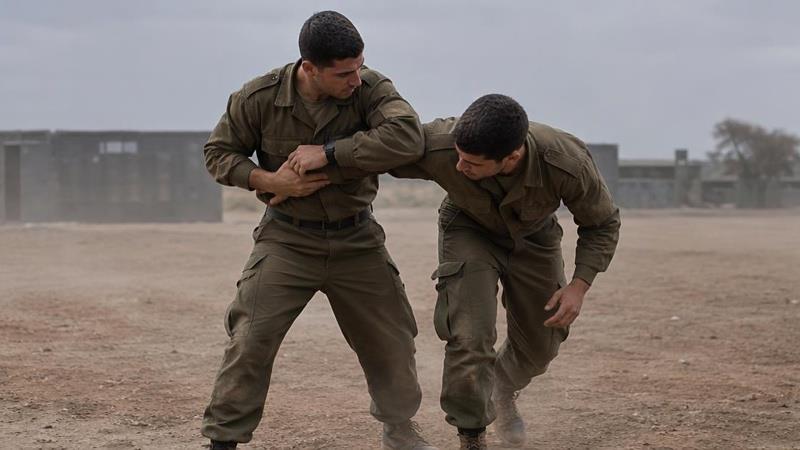
When civilians finally get to study real Military Combatives they usually realize pretty fast that most of their prior training in martial arts was designed to be practiced by healthy individuals with plenty of room to move in controlled environments under the watchful eye of an instructor or referee. Most training in military combatives, on the other hand, is done with the soldier so tired he can barely make it through the drill, on uneven or even damp surfaces with all sorts of trash scattered about and no referee to intervene on their behalf should things start to go south quickly. As a result, a lot of very useful training for violent street fights gets transferred to civilians studying Military Combatives for the first time. This field note will therefore look into more detail at this type of training than is covered in the initial summary above. Note, however, that this educational article is not intended to be a substitute for good training from a qualified, experienced instructor (military or civilian) and for legal advice – it is simply intended as a “door-opener” to the subject for responsible citizens.
The original field note
Most civilian martial arts train against a cooperative training partner. Classes are held on a smooth floor and each training session begins from a neutral position. As mentioned previously, military combatives training is the opposite of that described in the previous sentence.
Designed around the worst case
A common approach of Army programs like the Modern Army Combatives (MAC) system is to train a developmental approach to Close Quarters Combat (CQB) in a progressive manner starting with clinch work and moving to takedowns and ground fighting positions followed by submissions and eventually return to weapon use.
Here, I’ve highlighted a very important aspect of most military training programs – that of training while fatigued. The vast majority of techniques are taught in a simpler form and even the simple footwork is narrowed to ensure that a good portion of the technique can still be successfully completed while moderately fatigued.
A technique you cannot perform while breathing hard is not a technique. It is a demonstration.
As for what one focuses on in Military Combatives, the higher-priority techniques are the ones that alleviate worse situations (being in). So for example, escaping from being mounted on top is of higher value than a nice throw (to take someone down to the ground). Being in such a position is how fights end, and how one can get hurt badly.
A martial art meant for military training in combat may seem inappropriate for a civilian for a number of reasons but if you are looking for a self-defense martial art then it is certainly worth a look. Look for what has been left out of the curriculum. All good military derived systems remove options one by one to ensure that in the end the student is left with very few techniques that can be executed well under stress.
Practice should be measurable
A useful session has a clear purpose. For example, the ability to maintain balance whilst moving with a partner, recovering to a strong position after having been taken down, recognizing when distance to an opponent has decreased and being able to communicate with a partner to bring an end to a drill are all good examples of what to look for in a session.
The civilian objective is disengagement
Remember, military training is based upon missions, equipment, team support, and a chain of command. The civilian will have to look at the training of martial arts and self-defense in a completely different way. This is why in this article we will differentiate between training in martial arts and self-defense and how it is applied in a military setting.
Simple movement survives pressure
Self-defense training needs to focus on simple repetitive movements that can be executed under pressure. A good military-style self-defense program would focus on learning to balance, maintain good posture, protect one’s head, maintain a solid base of support, and then exit the situation in a safe manner. Such skills can be trained at slow drill-like speeds with students practicing against a partner or pad holder under the supervision of an experienced and qualified instructor.
Start with context
The title of this article is intended to open up a much larger subject. Much of what is of value to the military will be irrelevant to the civilian, much of it will be restricted by laws that govern the civilian, and the goals of the two will be different. Hence, it is wise to consider the article in two parts: first the general principles that can be of value to anyone; and second the details, which are of most use to those who are in units or can get themselves to classes of appropriate instruction.
What a responsible instructor looks for
Look for an instructor who can clearly show you the purpose of any drill and tell you how he or she limits the activities to safeguard the student. You should also see how the more experienced students react under stress as well as how the instructor corrects the student performing the drill at higher speed than normal. Lastly, make sure the new techniques learned can be applied in a larger sense to the entire training program and help build the student’s confidence.
Keep the lesson practical
The reader can go straight to the session description as a useful step to a training session. He can compare training schools, work on his general fitness, search for information on safety in his area, ask an instructor how he controls the pace of a live practice, and even note down what he learned from a particular session.
Limits are part of the lesson
No article, including this one, can provide the adequate amount of coaching. The quality of the best partner, safety of adequate protective equipment, as well as correction of a student, are factors that can’t be reproduced in an article. An individual’s health, previous injuries, as well as local laws and regulations, must also be taken into consideration when selecting the most appropriate training.
A reader’s checklist
- Identify which sections of the written lessons require equipment, other people or a dedicated training area specific to the army.
- Go for quality over sexy techniques.
- How will an instructor control the intensity of drill, and look after the interests of a complete beginner?
- Stop training if any signs of pain, confusion or weariness occur while performing any drills or techniques.
- Verify local laws and training guidelines prior to putting any general information into practice.
Closing perspective
“Why Choose Army Fighting Techniques?” must be approached with disciplined curiosity rather than mere imitation. Military programs are improved by repetition, review and the highest of standards. Therefore, the reader should apply these same parameters to training. Verify the original author and everything he or she says. Practice all techniques in appropriate environments. Set realistic objectives. Measure improvement by the increased ability to make safer and smarter decisions as well as by increased physical capacity.
Training note 1
This also goes for equipment! That’s why people train in comfortable clothes, on a clean floor and with the appropriate protective gear. This does not have to be expensive. The environment should be such that it allows for learning instead of creating a problem that the student then has to solve in training.
Training note 2
As with any form of development, progress is rarely linear. Some sessions will focus on improving your timing, whilst others look to shore up a weak area. It’s only when you find out in a safe environment, with the opportunity for you and your instructor to address the specific problem before increasing the intensity of your training, that you get the most from your sessions.
Training note 3
By having a training journal for sessions the student can log the purpose of the training session, note the changes to the conditions in which he/she trains and most importantly note what correction worked best for him/her. This in turn allows the student to better discuss their progress with the instructor instead of trying to remember every session.
Training note 4
All aspects of training must be managed, not least the equipment used. So, wear comfortable, suitable clothing, use an adequate training area and suitable protective equipment where required. Do not be misled by fancy or flash equipment that could actually pose a risk to you in training.