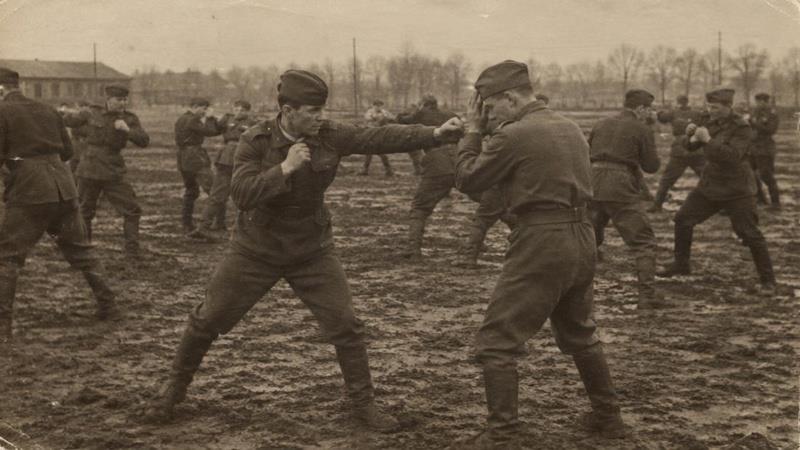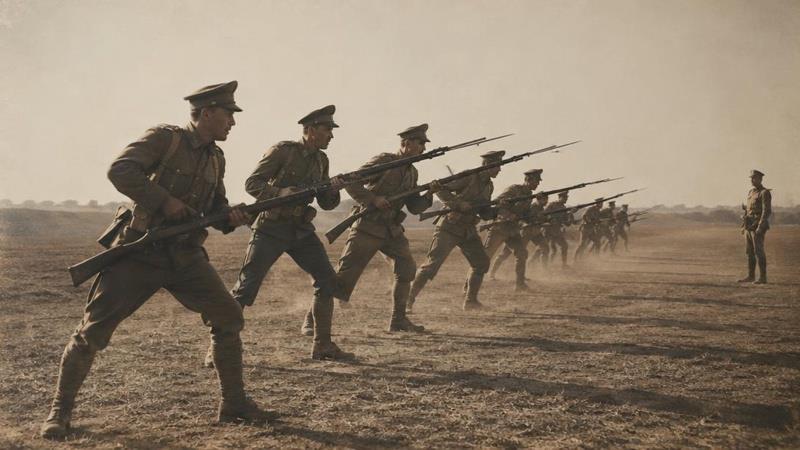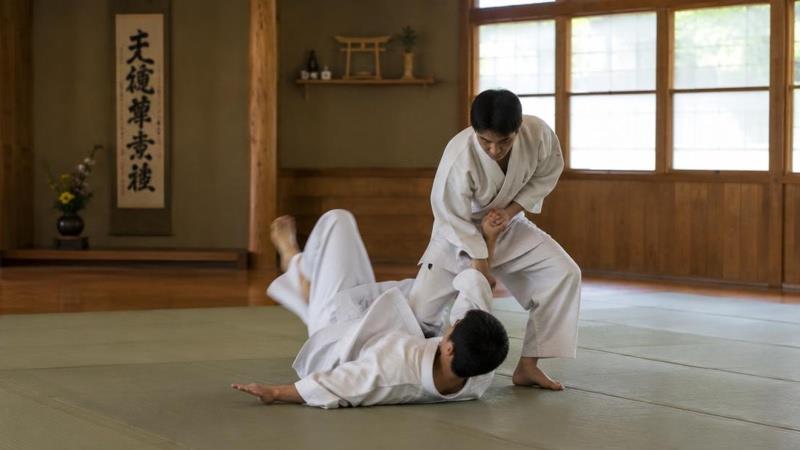
As previously detailed, military combatives consist of a combination of skills which have evolved from judo, boxing, and the Filipino blade systems. The point of the previous summary was to clarify what skills are used and how they have come to be included within military combatives. Suffice to say that the subject is worthy of more detailed coverage including historical development, appropriate training, safety and civilian perspectives.
The original field note
Military combatives can be summed up as a ‘stripped down’ martial art but what has been stripped away is just as important to know as what has been left.
What survived
Judo (throws and falls) – Boxing (guard and straight punches) – The Filipino blade systems that change in length with every advance (e.g. sword, dagger). All three combat systems function on the resistant opponent and thus were included in the development of the military hand-to-hand combat.
What disappeared
Long forms of movements, formal etiquette for entrance and departure as well as formal scoring for tournament fights can not be justified anymore in time-starved training environments.
Tradition teaches a patient body and a quick curriculum teaches quick bodies – for a soldier both are needed in the wrong proportions.
The martial arts keep a remnant of tradition for the masses. A proper bow, a strict line up at the beginning of class, specific etiquette at practice. All this keeps the school’s discipline intact.
In order to develop well rounded students a school needs to provide training that includes both tradition and curriculum in order to develop students that are both graceful and versatile.
Good partners make good practice
When looking for training partners it is also important that they are able to give you a good amount of realistic but controlled resistance. This can be done by having them communicate with you during the drill and protect themselves from any serious harm. As the drill progresses the amount of resistance that the partner is giving should also increase. The culture and environment of the training is just as important as the actual techniques that you are learning, as this is what allows students to make mistakes while still being able to learn from them.
Conditioning supports skill
Training for any art includes in it various components for developing mobility, aerobic power, grip and general recovery capabilities. This form of training is not an add-on to your training but rather a major component. Effort must be gradually increased, students must get plenty of sleep and take due care of their recovery. It is easy to tell when someone is working productively against resistance and when they are experiencing warning pain.
Systems are tools, not identities
Boxing, wrestling, judo etc. all have some very useful concepts to apply but a military program is restricted by time and by the tools available. That does not mean a school or program can’t draw on useful elements but they need to recognize the ‘program’ is actually a number of tools that have been assembled in a practical manner and a ‘style’ is no more than a label.
Start with context
So don’t misread the title of this article and go off on some tangental searches for “military style training”. As mentioned before, Military training has a few different primary objectives, is conducted with different equipment, and with different support. And it’s conducted under a different chain of command. It is NOT the same as civilian training programs, for a host of reasons.
What a responsible instructor looks for
The ideal instructor lays out the aim of the drill, sets limits for physical wear and tear and watches for the effects of exhaustion. In training, he corrects for speed of execution of movements, safeguards his more recent students from overexertion, and explains how the individual technique is adapted in overall training.
Keep the lesson practical
Reading this article on martial arts in military training can be quite practical. First, compare good programs. Improve your fitness in general. Look up local resources to improve your safety in martial arts. Ask your instructor how they control the live practice to ensure safe conditions for beginners. Finally, keep a record of all your good and not so good learning experiences. This can be a very small step towards becoming a more wise and skilled martial artist.
Limits are part of the lesson
All forms of training have limitations which cannot be covered in an article. Also any practice requires a good instructor, a suitable partner, protective equipment and a safe area to train in. In general every individual has different health problems, previous injuries that must be taken into account when practicing martial arts. Moreover every country has its own laws that prohibit certain techniques and training methods.
A reader’s checklist
- Identify which parts of the lesson depend on military equipment, a team or a controlled training area.
- Discern between the skills that develop posture, awareness, fitness and safe decision making and those skills that are to be practiced (only).
- How would an instructor control intensity and begin to look after more experienced students?
- Stop practicing when you are suffering from pain, confusion or fatigue.
- Verify that local laws and that a sufficient amount of relevant information is supplied in your locality before relying on the material outlined here to form a plan.
Closing perspective
“Traditional Martial Arts in Modern Military Training” should evoke disciplined curiosity rather than blind imitation by the reader. Military training systems evolve through repetition, review, and strict standards. Thus, for example, traditional Martial Arts can best be recommended to the civilian by teaching him or her to verify information about the subject through other, independent, sources, to practice accordingly, to maintain objective, realistic goals, and to measure progress in terms of improving safer decisions in addition to improved physical performance.
Training note 1
Most equipment has limited value. Focus on good quality training clothes, practice on safe surfaces and choose the best protective equipment for the task at hand. Don’t let the attraction of gear that you can use on the mat deter you from choosing the best. Focus on the environment that will allow you to train safely.
Training note 2
Training is not linear. While you may be working on your timing in some sessions, in others you may be exposed to weaknesses in your base or decisions made too late. Recognizing these in controlled practice and having them to work with before you increase the intensity of your training is valuable.
Training note 3
By noting the aim of a session, the conditions that changed and what made the greatest difference to help improve, in time it will be possible to discuss progress with an instructor of a school, instead of relying on memory of a very demanding class.
Training note 4
Equipment also should be used with caution. Rather than buy all sorts of gizmos and doo-hickeys looking for extra bells and whistles in their training equipment, students and teachers alike would be better off finding comfortable training clothes, a good safe surface to practice on and appropriate protective gear to use in their lessons.
Training note 5
Progress in martial arts is not typically a linear function. There are some classes focused on improving timing of particular techniques, others reveal basic weaknesses or decisions taken too late. These problems, found in a controlled environment, are of the greatest value. They give a clear focus for both student and instructor on how to proceed to increase intensity of training.