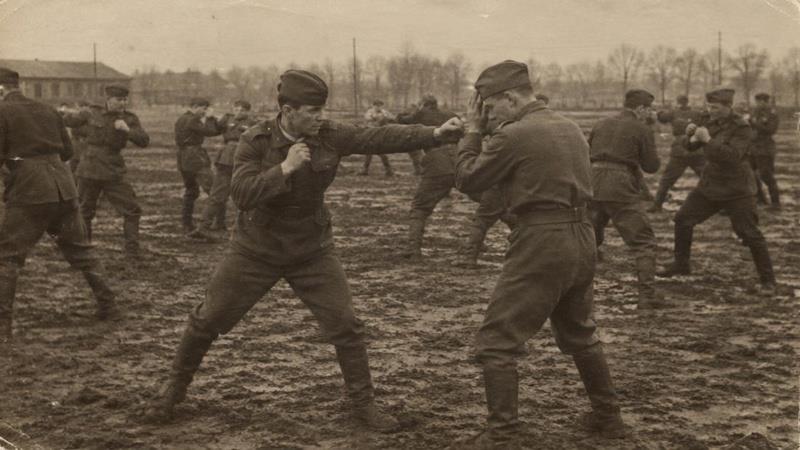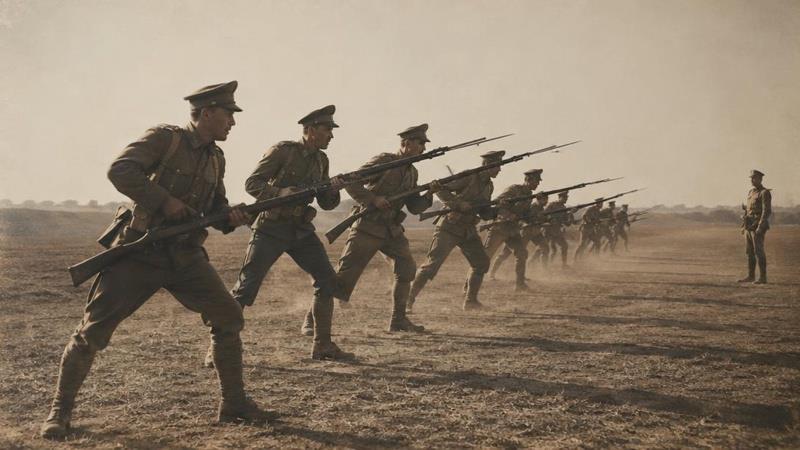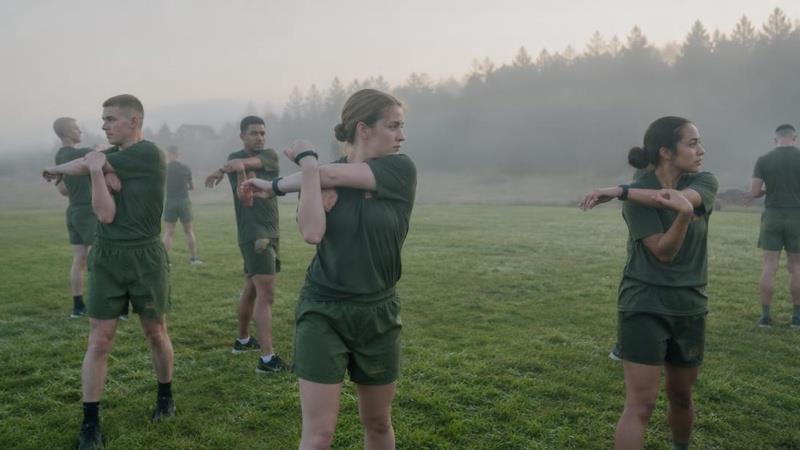
The first months of military training are generally to destroy the recruits’ bodies far more than they are to test their strength. Building strength and mobility before arrival at the military training facility is described in practical terms in the above summary. However, this subject deserves far more space than has been given here. In the following discussion, historical background, the training environment, safety and a civilian perspective are added to the original subject of building strength and mobility prior to arrival at the military training facility. This is educational material and is not intended to be used as a sole means of learning how to prepare for military training. It should be used in conjunction with supervised training and/or with the assistance of legal advice as required.
The original field note
In general, new recruits join up with good levels of strength but have very limited ranges of movement and therefore are often injured in the first few months of training for reasons other than lack of strength.
The positions that matter
Most of the major movements required by any training cycle can be covered by testing four fundamental positions. The first is a deep squat, and the second is a full overhead reach. A half-kneeling position on one hip is also very relevant and finally a single-leg stance on one leg with your hands on your hip for balance.
Strength that carries
Loaded carries, step-ups, push-ups and pull-ups are all excellent ways to build pattern of effort for specific military tasks. Heavy backpacks make far better trainers than do leg presses.
Mobility is not stretching. It is the ability to produce force in an awkward position without paying for it later.
Twelve weeks of twice-weekly mobility and two strength training sessions will not make you an athlete but it will help you get through the first month of your military training.
Build capacity in layers
As mentioned above, combat fitness is not just one grueling workout. In essence, there is a base layer of running and/or walking to build up endurance, and on top of that, strength work of various sorts, mobility, and recovery to build up capacity for further physical exertion. All of this has to be done consistently, and in the meantime, it has to be possible to train without causing damage to joints and the like.
Consistency beats occasional punishment
Rather than strive for one extreme workout, opt for a regular series of workouts that can be built up slowly over time. This does not have to be complex and can even include the monitoring of simple measures to gauge your progress and aid recovery. Work can be increased in small increments, but remember to include plenty of ‘easy’ days to allow for adequate recovery between sessions.
Train for the actual requirement
For military training in particular we look for exercises that mimic a carrying load, changes of level, long periods of steady state activity, and the ability to recover for breathing. These can be done with ordinary gym equipment and with sensible progression. We never do an exercise that causes sharp pain, dizziness or loss of control and we assess whether or not to continue an activity that causes such symptoms.
Start with context
The article title will form the basis of our longer explanation to the different elements that comprise Military Training. These articles are written within a specific military context and therefore the reader must be able to discern between the training principles and specific details within the article that are only relevant within a specific military unit or training program and with a specific instructor.
What a responsible instructor looks for
They make sure their students understand the purpose of the drill. They set limits to the students' activities and monitor them as they tire. They point out errors in speed of movement and teach the new student(s) how to complete a task safely. The new skill must be applied within the overall training program and the student must be able to apply it confidently in all circumstances.
Keep the lesson practical
The reader can turn this article into a very practical action plan to learn a new skill or physical activity within a few weeks. In addition to reviewing reputable programs and generally increasing fitness to prepare for physical activities, local safety information, as well as fitness information for particular activities, can be reviewed. Additionally, information about live practice (also referred to as drills) and how such a practice would be controlled for new participants can be very valuable. The best part is that all of this can be done in the reader’s spare time, and within a few weeks of time, a number of useful skills can be learned with a lot of practical value.
Limits are part of the lesson
No amount of written information can replace a qualified coach, a suitable training partner, suitable protective training gear and most importantly, personal correction and feedback. A trainee’s past injuries, current health problems, as well as the local laws governing physical activity also need to be taken into account.
A reader’s checklist
- Identify which parts of the lesson rely on military equipment, a team or a controlled training area.
- Prioritize practice of posture, awareness, fitness and safe decision making over untested techniques.
- Ask how an instructor controls intensity and protects beginners.
- Stop when pain, confusion or fatigue makes movement unsafe.
- Verify local laws, and use relevant expert guidance, for any aspect of training covered by this general information.
Closing perspective
“Strength and Mobility for Recruits” can serve as a useful primer for recruits to learn about strength and mobility training and how to improve at it through disciplined and curious practice. Military programs and training improve by way of repetition, review, and strict adherence to high standards. Similarly, in civilian training, one would serve themselves best by verifying information from credible sources and practicing all techniques in appropriate settings with realistic objectives for improvement.
Training note 1
A good training journal will record why you did a session, what changed and what worked best for you. That information can then be discussed with an instructor to log your progress.
Training note 2
A good set of training equipment includes comfortable clothing, a safe surface for training and sufficient protective gear. Do not confuse good quality equipment with expensive accessories that could even pose a hazard in training. Use the training environment to support your training and learning.
Training note 3
Many sessions can target different aspects of skill and so whilst the timing may improve in one session the base of skills may have been exposed to be somewhat lacking in another session. It is good to identify specific problems in controlled practice before they surface when the intensity is increased.
Training note 4
A training journal records the details of your training sessions: objective, conditions, and the biggest change for you. This allows you to go back to your training sessions and have the best discussions with your instructors.
Training note 5
This is equally as true for training equipment, as opposed to clothing, and one must ensure that they have the best possible to train safely, but do not feel pressured into buying overpriced accessories that would only serve to add further hazards to your training.