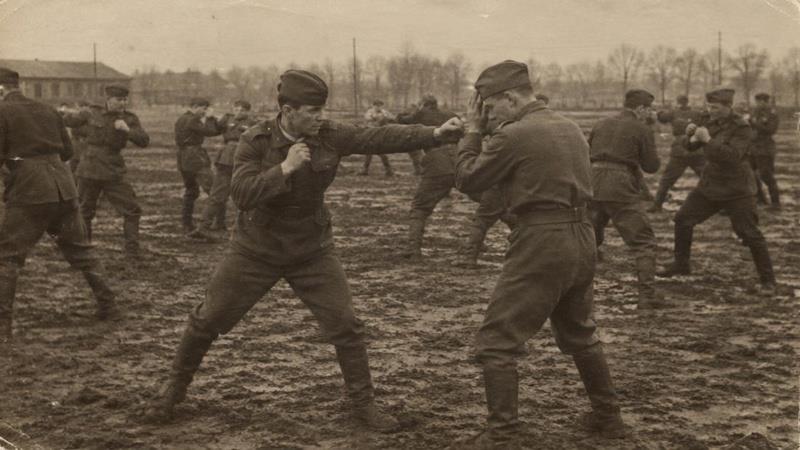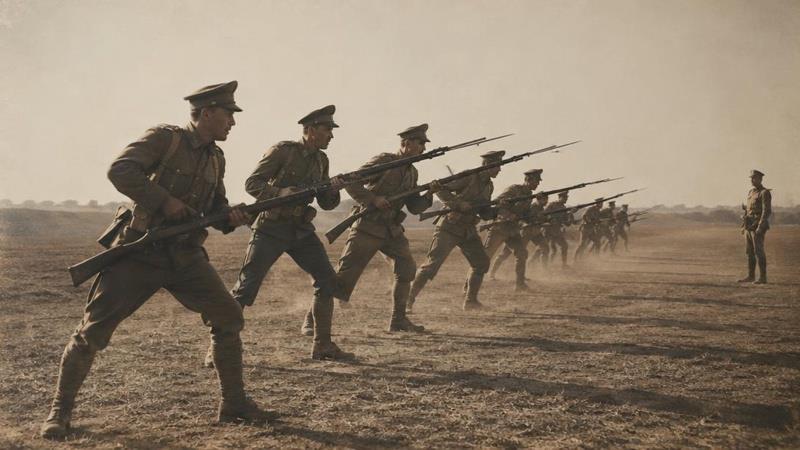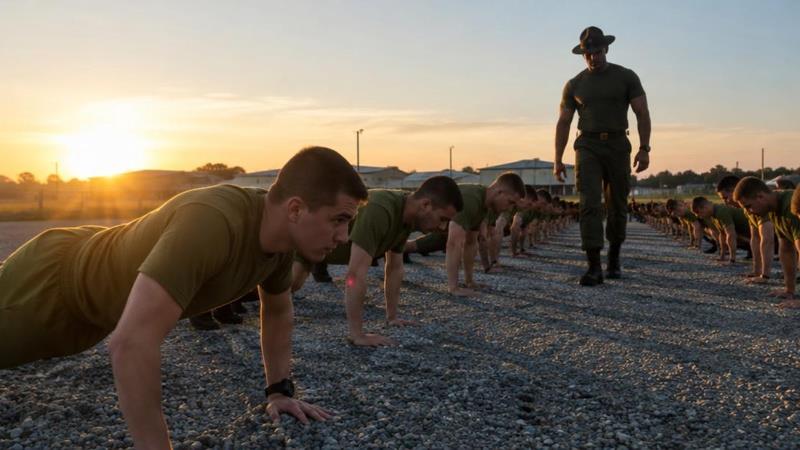
A good fighting body has three primary components: a solid core, a large aerobic base, and impact tolerant joints. The following article provides a summary of how military conditioning is set up for developing such a body. While the summary above is sufficient for getting an idea of how military-style training is set up for building a good fighting body, the full article will dive much deeper into the subject to provide a more comprehensive discussion of the topic including its historical roots, how it is implemented in various training programs, safety considerations, and how it can be applied by individuals to improve their physical fitness for self-defense.
The original field note
Combat Fitness or Military Conditioning is not about becoming a body builder but about building a body that can carry heavy loads and absorb shock while continuing to function under extreme physical stress.
The trunk is the transmission
Loads are placed on the trunk for all strikes, clinches and escapes. Hence, loaded carries for distance, anti-rotation work and hinge work with heavy loads for strength are preferred over work for isolated development of the abdominal muscles for strength. For Strength Training Load Carry (for distance) Plank (for anti-rotation) Hinge (for strength) Deadlift <
Aerobic base, not just intervals
When it comes to cross-training, it does not matter how fast a recruit can run five miles for their test, what matters is how slowly they can run long distances for their conditioning in order to recover well between events.
Conditioning is not the ability to go hard. It is the ability to come back down and go again.
Contact is a skill
However, body armour, falling to the ground and training with partners replicate contact loads far better than most gym equipment. Training with these in gradated increments, also neck work and grip work, will help to mitigate the risk of serious injury during training.
Three strength sessions, two jog sessions of easy running and one very tough conditioning session is all most civilians need to develop a sound military-style fitness base.
Train for the actual requirement
Instead look for military training programs that include exercises such as: carries (with various types of loads); changes of level (e.g. up and down stairs); steady state movement (e.g. jogging, running); and the recovery of breathing after intense physical effort.
Build capacity in layers
Combat fitness is not one workout. In addition to building a solid aerobic base, building strength in exercises that work your entire body using safe ranges of motion and developing flexibility, your body will thank you for enabling it to recover from all the fitness work you do to be a better Soldier.
Consistency beats occasional punishment
Go for consistent, small steps in your fitness training and track the few simple measures that matter most to you. Gradually increase the intensity and volume of your work, but also leave room for recovery on easier days. Fitness training should help you to become more capable in all sorts of situations, not just to experience the discomfort of an occasional very hard workout.
Start with context
This article is not a quick fix or a “cheater’s guide” to any particular military skill or task. In other words, the subject of an article is generally much larger than what can be covered in a single article. For this reason, the article must be read keeping in mind the larger subject matter, and the details that are specific to a particular unit or skill being taught in a controlled environment (i.e. supervised training program).
What a responsible instructor looks for
A qualified instructor making sure you understand the purpose of the drill and its boundaries. They will correct your speed of movement and protect newer participants from overexertion. They will tell you how what you learn in that drill applies to the rest of your training. The instructor’s behavior will create confidence in the training.
Keep the lesson practical
You can use the above article as a ‘primer’ to go and find out more about Physical Conditioning for Combat Readiness. Compare different programs and courses, get in general shape, read up on local safety issues, ask an instructor about live practice and how he or she would control it for new students. Just one small step is better than trying to learn some new, untested and unwise technique from a video.
Limits are part of the lesson
No article can ever replicate a good coach, a good training partner, relevant safety equipment and personal correction. Every individual has different health constraints and different past injuries, and is governed by different local laws. So treat any written material on physical training as mere orientation – and take the most conservative possible view on anything that might have severe consequences for mistakes. Find someone who can teach you properly.
A reader’s checklist
- Do you know which parts of the physical training are done with the help of special military equipment, a team or in a specially equipped training area?
- Preference of learning physical conditioning techniques for posture, awareness, physical fitness, and for safe decision-making over practice of unverified techniques.
- Ask how an instructor controls intensity and protects beginners.
- Stop when the session becomes unsafe due to pain, confusion or excessive fatigue.
- Verify local laws and a club’s or organization’s standards before using the information in this article for physical training.
Closing perspective
“Physical Conditioning for Combat Readiness” can serve a purpose only if it fosters disciplined curiosity as opposed to an uncritical imitation of all things military. After all, military programs are developed, tested and improved through repetition, review and strict standards. As with any other physical activity or program the same principles can be transferred to civilian training by verifying the source, practicing in appropriate settings, keeping the objective realistic and measuring progress in terms of safe decision-making in addition to physical performance.
Training note 1
Sessions improve in areas specific to training, some enhance a student’s overall fitness while others highlight a weak area or decision made too late. Identifying these areas in a controlled environment allows the student and instructor to focus on solving that specific problem before increasing intensity.
Training note 2
A training journal can be used to record what you learned from a training session. Write down the objective of the session, the changes to the conditions and the most effective correction used. You can then refer back to this in a later training session and even discuss it with your instructor.
Training note 3
Just as a learning environment would not contain hazards that a student would be expected to ignore, similarly, equipment used in physical training should be relevant. This means that students should train in comfortable clothing, on safe surfaces and with the proper protective gear.
Training note 4
A student’s progress in physical training is rarely linear. In some training sessions students might work on their timing while in others they might discover a weak base or a late decision. However, in controlled training sessions such weaknesses are very valuable because they present a specific problem for the student and the instructor to work on before raising the intensity of training.
Training note 5
A training journal of useful length contains a brief description of the session, an outline of changes to conditions, and the most useful correction. This can form the basis of a very useful conversation with your instructor after a hard session – much more useful than relying on memory.